

Why We Cut Only Forty
May 5, 2026 · 2 min read
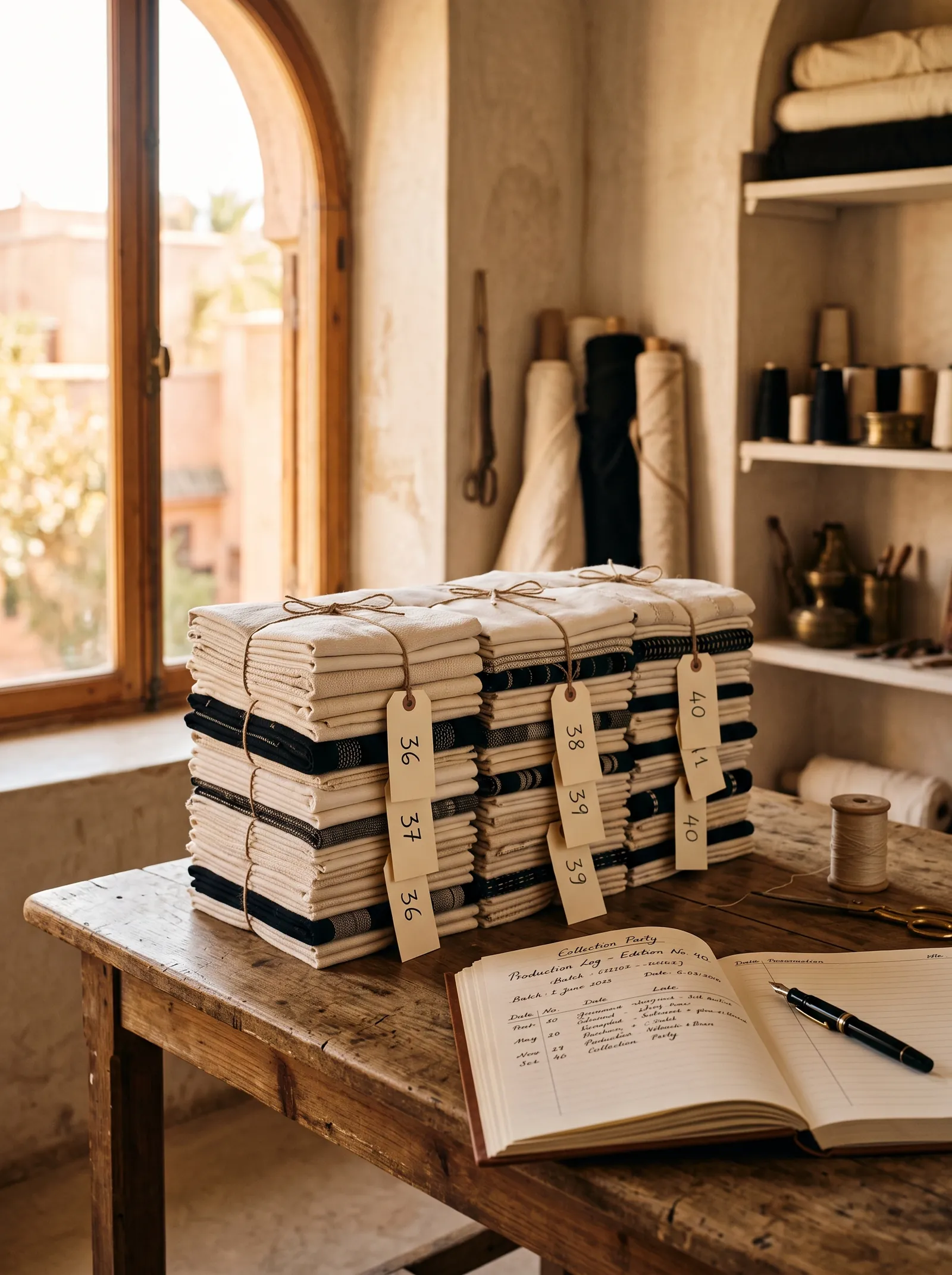
When people hear that every design we release is limited to forty pieces at most, they sometimes assume it is a strategy. Scarcity sells, after all. The real reason is duller: forty is roughly what the atelier can finish in a season without hurrying a single seam.
A house that produces endlessly remembers nothing.
The ledger
Each edition lives in a leather bound ledger at the atelier. When a design is approved, its run size is set and written down. As each garment is finished, it is logged against its number and date, and its card is signed by the artisan who completed it. When the last piece sells, the pattern is archived. No reissues, no new colourways.
One run, one cutter
Every panel of every piece in an edition passes through the same hands. This is why a run holds together, and why two pieces from the same edition, held side by side, share small habits of finishing that a second cutter would never reproduce.
What you actually own
Your garment carries a number, a date, and the name of the person who finished it. It will not be mass produced later, and it will not return next year in a different colour. The practical consequence is that when something in our collection speaks to you, waiting is a decision too. The Dhahab Silk Ensemble is the current example: a short run, numbered, and dependent on a thread we may not be able to source again.
What the number protects
The number does two jobs. It keeps the artisan from being asked to hurry, which is the same as keeping the garment from being cut by tired hands. And it means a wardrobe built from numbered pieces cannot be duplicated by anyone, at any price. Scarcity that comes from marketing expires with the campaign. Scarcity that comes from hands does not.
There is a quieter reason we hold the line at forty, and it has to do with memory. The atelier remembers every edition it has closed: the cloth, the season, the woman who bought the final number. We would rather the ledger read like a family album than a spreadsheet.
Maison K-Loh · Made in Morocco
 When You Are Between Two Sizes
 Dressing for a Wedding When You Are Not the Bride
 Packing a Caftan So It Arrives Ready